How to Accurately Measure Your Height (Step-by-Step Guide)
Measuring your height at home is simple when the correct method is followed. If someone is available to help, the process can be even easier and more accurate. However, even if no one is around to assist you, you can still measure your height by yourself using the step-by-step method described below.
While browsing discussion forums and social platforms like Reddit and Quora, I noticed a common question people keep asking: “How can I measure my height perfectly?”
People simply want an accurate number, but they often get confused by the different methods and wonder which one is actually accurate. Accurate measurement is not complicated, but it does require the right positioning and a careful method.
Following a standardized approach helps eliminate the most common errors.
How Do You Measure Height Correctly at Home?
The correct method is simple. But small details make a big difference. If you want an accurate result at home, follow these steps carefully.
Things you’ll need:
- A flat wall
- A hard, flat object (book or ruler)
- A pencil
- A metal measuring tape
Steps to Measure Your Height
- Stand on a hard, flat surface, not on carpet.
- Remove your shoes before measuring.
- Keep your heels, hips, shoulders, and upper back against the wall.
- Look straight ahead with your head in a neutral position.
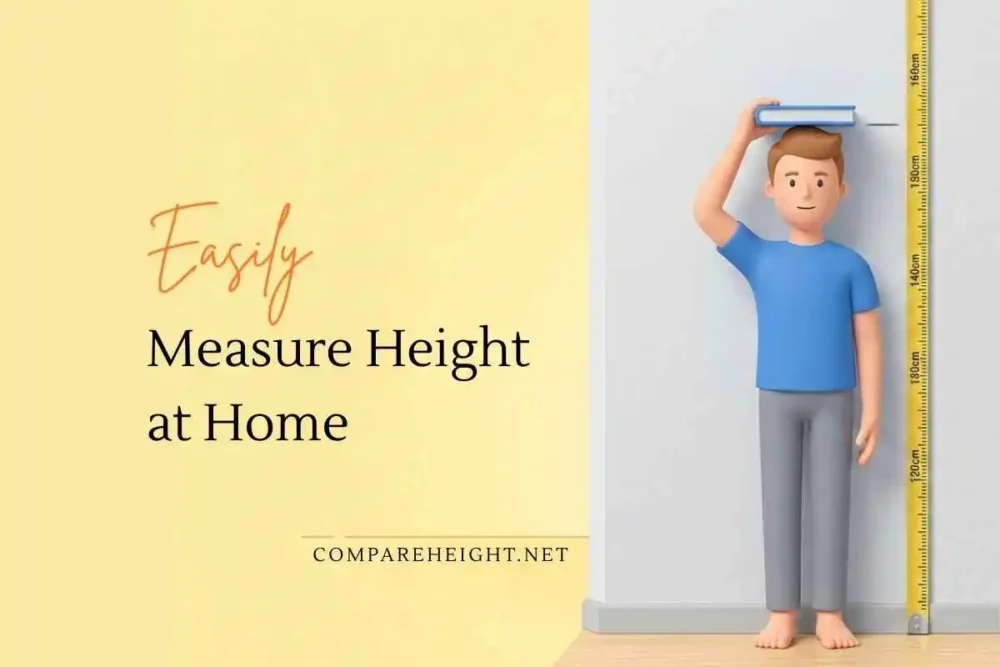
- Place a flat object on top of your head at a right angle to the wall.
- Mark the point where the object touches the wall.
- Measure from the floor to the mark using a straight metal tape.
- Repeat once more and take the average for better accuracy.
Common Mistakes to Avoid When Measuring Height at Home
- Don’t measure on carpet or uneven flooring.
- Don’t wear shoes, slippers, or thick socks.
- Don’t tilt your head up or down while measuring.
- Don’t stand with bent knees or slouched posture.
- Don’t use soft objects like cushions to mark your height.
- Don’t angle the measuring tape away from the wall.
- Don’t rely on a single reading without rechecking.
- Don’t measure your height while lying down — standing height and body length are not the same.
- Don’t compare morning and evening measurements without considering natural height changes.
Height Measurement Tools Used by Professionals
At home, a simple wall and measuring tape can provide a fairly accurate result when used carefully. However, medical professionals and researchers rely on specialized instruments designed specifically for height measurement. These tools help reduce human error and ensure consistent readings across different individuals and settings.
Below are the most commonly used tools for measuring height.
Stadiometer
A stadiometer is the standard instrument used in hospitals, clinics, and research settings to measure a person’s height. The device includes an upright measuring rod mounted on a stable base and a sliding horizontal headpiece that is placed on the crown of the head during measurement. Stadiometers are considered one of the most reliable methods for measuring standing height and are widely used for clinical assessments and growth monitoring.
Common types of stadiometers:
- Wall-mounted stadiometer (fixed to a wall)
- Freestanding stadiometer (standalone with a base)
- Portable stadiometer (foldable/lightweight)
Medical Scale with Height Rod
Many medical facilities use a weighing scale with an attached height rod. This device allows healthcare providers to measure weight and height during the same assessment. This setup is commonly used during routine medical examinations because it allows both measurements to be taken quickly.
Steps to Measure Height
Although different instruments may look slightly different, the basic process used in clinics and health assessments is generally the same.
- Remove shoes, hats, or bulky hair accessories before measurement.
- Stand upright on the base platform or flat surface.
- Keep heels together and back straight.
- Position heels, hips, shoulders, and upper back aligned with the measuring surface when possible.
- Look straight ahead with your head in a neutral position.
- Lower the headpiece slowly until it touches the crown of the head.
- Ensure the headpiece is level and forms a right angle with the measuring rod.
- Read the measurement at eye level for accuracy.
- Record the measurement and repeat if verification is needed.
Common Mistakes to Avoid
Even professional tools can give inaccurate readings if the measurement is not performed correctly. The following mistakes are among the most common causes of incorrect height measurements.
- Wearing shoes, thick socks, or footwear during measurement
- Standing on an uneven or soft surface
- Tilting the head upward or downward instead of looking straight ahead
- Slouching or bending the knees while standing
- Allowing the headpiece to rest on the hair instead of the crown of the head
- Leaning away from the measuring surface or shifting body weight
- Taking the measurement quickly without ensuring proper alignment
Avoiding these small errors helps ensure the measurement reflects a person’s true standing height.
Height Measurement Apps
Smartphones now include built-in sensors and augmented reality features that allow users to estimate height using the phone’s camera. Because of this, many people look for simple ways to measure height with a phone without using traditional tools. While these apps can be convenient for quick estimates, they rely on visual detection and distance calculations, so the result may not be as precise as measurements taken with a tape measure or a stadiometer.
Basic Steps to Measure Height With a Phone
- Open a height-measuring app or an AR measuring app on your phone.
- Stand the person straight against a flat wall.
- Hold the phone steady and point the camera toward the person.
- Let the app detect the floor and the top of the head.
- Align the on-screen marker with the head if needed.
- The app will display the estimated height.
Common Mistakes to Avoid
- Holding the phone at an angle instead of keeping it steady
- Measuring in poor lighting, where the camera cannot detect edges clearly
- Standing away from the wall or moving during measurement
- Expecting the result to be as precise as professional measuring tools
For a detailed guide on how to measure height with a smartphone, including accuracy tips and supported devices, read our full article.
How to Convert Height in Different Units?
Height can be recorded in different measurement units depending on the region or system used. The most common formats include centimeters (cm) in the metric system and feet and inches (ft, in) in the imperial system. In some cases, height may also be expressed only in inches. Because these systems are widely used around the world, height measurements are often converted from one unit to another for clarity and consistency.
Simple Height Conversion Formulas
Convert Centimeters to Feet
Feet = cm ÷ 30.48
Convert Centimeters to Inches
Inches = cm ÷ 2.54
Convert Feet to Centimeters
cm = feet × 30.48
The table below shows a few common height conversions from feet and inches to centimeters and meters.
| Height (Feet & Inches) | Height (Centimeters) | Height (Meters) |
|---|---|---|
| 4’6’’ | 137.16 cm | 1.37 m |
| 4’7’’ | 139.70 cm | 1.40 m |
| 4’8’’ | 142.24 cm | 1.42 m |
| 4’9’’ | 144.78 cm | 1.44 m |
| 4’10’’ | 147.32 cm | 1.47 m |
| 4’11’’ | 149.86 cm | 1.50 m |
| 5’0’’ | 152.40 cm | 1.52 m |
| 5’1’’ | 154.94 cm | 1.54 m |
| 5’2’’ | 157.48 cm | 1.57 m |
| 5’3’’ | 160.02 cm | 1.60 m |
| 5’4’’ | 162.56 cm | 1.62 m |
| 5’5’’ | 165.09 cm | 1.65 m |
| 5’6’’ | 167.64 cm | 1.67 m |
| 5’7’’ | 170.18 cm | 1.70 m |
| 5’8’’ | 172.72 cm | 1.72 m |
| 5’9’’ | 175.26 cm | 1.75 m |
| 5’10’’ | 177.80 cm | 1.77 m |
| 5’11’’ | 180.34 cm | 1.80 m |
| 6’0’’ | 182.88 cm | 1.82 m |
| 6’1’’ | 185.42 cm | 1.85 m |
| 6’2’’ | 187.96 cm | 1.87 m |
| 6’3’’ | 190.50 cm | 1.90 m |
| 6’4’’ | 193.04 cm | 1.93 m |
If you want a quick visual reference, you can also use our height comparison chart. This interactive tool lets you compare heights side by side and instantly convert between feet, inches, centimeters, and meters.
Why Accurate Height Measurement Matters?
Accurate height measurement is important in several everyday and professional situations. Even small measurement errors can affect records, calculations, and health assessments.
In healthcare settings, height is used together with weight to calculate body mass index (BMI), which helps professionals evaluate general health and nutritional status. Accurate measurements are also important for monitoring growth and development in children and adolescents.
Height measurements may also be required for medical records, fitness assessments, sports evaluations, and official documents where precise information is necessary. In addition, researchers and health professionals rely on accurate height data when studying population health, growth patterns, and physical development.
For these reasons, using the correct method and proper measuring tools helps ensure that height measurements are reliable and consistent.
FAQs
Once you know your accurate height, you may also be curious about how it compares with global averages. If you’d like to explore this further, we’ve covered it in detail in our article on average human height worldwide.
You can also explore our tools and guides to compare heights, convert measurements, and better understand height statistics.